
Predictable lead time
Fabrication capacity is company-owned, so the production schedule is negotiated directly with the team that must meet it — and shipping milestones are commitments, not estimates from an external mill or assembler.
Every unitized curtain wall panel that leaves No.258 Xintao Road, Qingpu Industrial Park, Shanghai has passed six defined process steps — and a quality checkpoint at each one. This is the factory story behind predictable lead times and auditable quality.
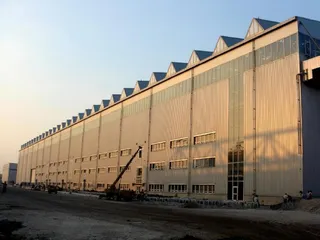
Hanart's fabrication facility is part of the same organization that engineers and installs the envelope — not an external supplier. Located in Qingpu Industrial Park, Shanghai, it serves both the domestic landmark portfolio and export projects such as 166 Perry Street in New York. That integration is the structural reason behind two of the most-cited reasons owners choose us: fabrication schedules are company commitments, and every panel can be traced to the drawings, materials and inspection records of a single accountable team.
The plant focuses on unitized curtain wall systems — factory-assembled panels delivered to site as complete units — plus associated framing and panel assembly for high-performance envelopes. Because the panel is assembled, sealed and tested indoors, the environmental variables that degrade on-site workmanship (dust, temperature, humidity, weather) are controlled before the product ever reaches the building.
Each step names its quality control point, because quality in a unitized system is engineered into the sequence, not inspected onto the finished product.
| Step | Operation | Quality checkpoint at this stage |
|---|---|---|
| 1 | Cutting & CNC machining of profiles | Dimension and angle verification against shop drawings; machining tolerances enforced by program parameters |
| 2 | Frame assembly in alignment fixtures | Squareness and diagonals checked per panel; fixture-based assembly removes reliance on individual skill |
| 3 | Unit assembly — glazing, panels, hardware | Glass and infill placement verified against unit schedule; hardware torque and positioning recorded |
| 4 | Sealant application in controlled conditions | Joint geometry, sealant depth and continuity inspected; curing environment (temperature/humidity) controlled |
| 5 | Water-spray & airtightness verification | full pre-dispatch water-spray testing of sealed units; airtightness performance per project specification |
| 6 | Packing, labeling & loading | Export-grade packing; unit identity tracking to drawings; loading sequence matched to site hoisting plan |
CNC machining gives dimensional repeatability, but it is the fixture-based frame assembly and the controlled sealant environment that produce a unit whose performance matches its test certificate. The water-spray test at step five is not optional sampling — it is applied to every unit before dispatch, which is why seal-related site defects are the exception in Hanart-delivered projects rather than a known risk to be managed.
Curtain wall performance is classified against China's national standard GB/T 21086 and international project specifications. The factory verifies the three properties that dominate envelope performance risk: air permeability (uncontrolled airflow through the facade), watertightness (resistance to water penetration under driving rain pressure) and wind load resistance (structural integrity of the unit under design wind pressures).
For export projects, verification results are documented per project and made available to the owner's inspection team — including, where the contract calls for it, witnessed testing on representative units. What is measured in the factory is exactly what the installed facade must deliver, so the same yardstick follows the panels to the site.

Fabrication capacity is company-owned, so the production schedule is negotiated directly with the team that must meet it — and shipping milestones are commitments, not estimates from an external mill or assembler.
Every process checkpoint is documented and traceable to unit identity. A client's inspection team can walk the line, witness testing and match panels to shop drawings before a single container leaves.
The facility is two hours from Shanghai's airports. Owners, consultants and general contractors are welcome to audit production mid-run — seeing the step-five water-spray test on your own units is the strongest pre-contract evidence available.
Fabrication technology and inspection system → Why unitized systems →
Arrange a visit or request the facility documentation and process-quality summary — we will provide the factory guide and the test protocols in advance.