
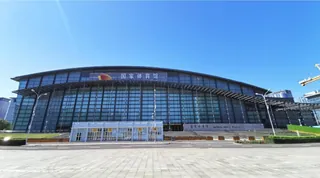
Luban Prize 2008 · Sports
National Indoor Stadium, Beijing
Metal roof and facade systems for an Olympic venue delivered under Games deadlines.
Case study →Shanghai Hanart is a curtain wall company in China that engineers, fabricates and installs unitized curtain walls and metal roofing systems under one contract — with the audited fundamentals of a top-50 contractor behind every bid.
Clash detection, wind-load verification and performance simulation before fabrication begins.
Engineering process →Point-supported and cable-net glazing with load-path verification for atrium and landmark façades.
Structural systems →CNC machining, sealant conditioning and 100% water-spray testing before panels leave Qingpu.
Fabrication QA →Air permeability, water tightness and thermal transmittance tested against GB/T 21086 protocols.
Performance data →Procurement teams and consultants verify these credentials before shortlisting. We keep them visible and current — because the verification stage is where real bids are won or lost.
National Quality Engineering Award — the highest construction prize in China.
Quality, environmental and occupational health management systems certified since 2005.
Ranked among China's top 50 curtain wall contractors every year since 2005.
Licensed overseas contractor since 2009 — the legal basis for every international delivery.
Accredited in-house testing: air permeability, water tightness, thermal performance.
Proprietary curtain wall anchoring, sealing and energy-saving systems held since 1995.
Every badge above links to a verifiable document. View certification dossier →
Choosing a curtain wall company usually means stitching together a designer, a fabricator and an installer as separate parties — and paying for every misaligned boundary between them. Hanart was founded in 1995 on the opposite model: one team designs, manufactures, installs and stands behind the finished envelope. The six Luban Prizes on our project record are the measurable outcome of that structure, not a marketing claim.

Every envelope starts as a performance problem: wind loads, thermal transfer, air and water tightness, erection sequence. Hanart's in-house engineering team runs structural verification, thermal analysis and BIM coordination before fabrication begins — the stage where errors cost the least. For precision projects such as the Shanghai Synchrotron Radiation Facility, where stability requirements affect the envelope itself, this design depth is what makes the difference between a facade that performs and one that merely looks right.
The factory at No.258 Xintao Road, Qingpu Industrial Park is where schedule risk is retired. Unitized panels are cut, assembled, sealed and tested in a controlled environment, then verified with full water-spray testing before they leave the building. Owning production does not just shorten lead times — it makes quality a process you can audit instead of a promise you must trust. The same line that served the New York market on 166 Perry Street demonstrates that export-scale fabrication is routine, not exceptional.
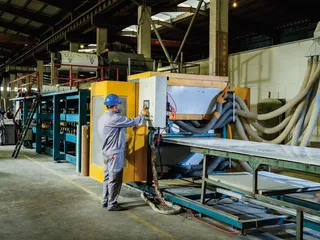
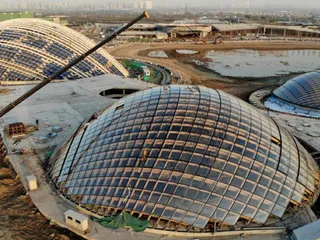
On site, the same discipline applies: engineered lifting plans, safety management aligned to ISO 45001 (GB/T 28001), and schedule control that treats the envelope as a critical path, not a finishing trade. This is how Hanart completed desert-climate work for the Asian Olympic Council in Kuwait and cold-climate delivery at Grand Plaza in Ulaanbaatar — two projects where installation planning, not product quality, was the real test. After handover, the same team remains reachable for inspections and maintenance.
The Luban Prize is the highest engineering-quality award in China's construction industry. Hanart holds six — stadiums, museums, an aircraft assembly hall, an airport and a major research facility among them. Each card below links to the full case study.
Metal roof and facade systems for an Olympic venue delivered under Games deadlines.
Case study →
Stone cladding and point-supported glass resolved into a sculptural museum envelope.
Case study →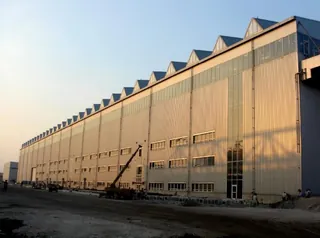
Large-span standing-seam metal roofing that keeps an aircraft production hall dry.
Case study →
Terminal curtain wall and long-span roof drainage engineered for zero-leak operations.
Case study →
Precision envelope for a national research facility where stability is part of the science.
Case study →
Unitized curtain wall for a commercial complex — factory panels, fast urban erection.
Case study →Since earning China's overseas contracting qualification in 2009, Hanart has delivered facades across North America, the Middle East and Asia-Pacific. The Qingpu factory ships panels; local offices in the United States, Canada, Puerto Rico, Mexico, Chile, Ecuador and the UAE coordinate installation and aftercare.
Unitized glass tower envelope exported from Shanghai and coordinated across 12 time zones.
Project →Thermal-break commercial curtain wall engineered for −40°C winters.
Project →Solar-control glazing and sand-resistance sealing for a Middle East landmark.
Project →North American coordination backed by Hanart's office network and export logistics.
Region →The Qingpu plant fabricates every unitized panel; the map below shows where the finished envelopes have been installed — and the delivery network that coordinates each market.
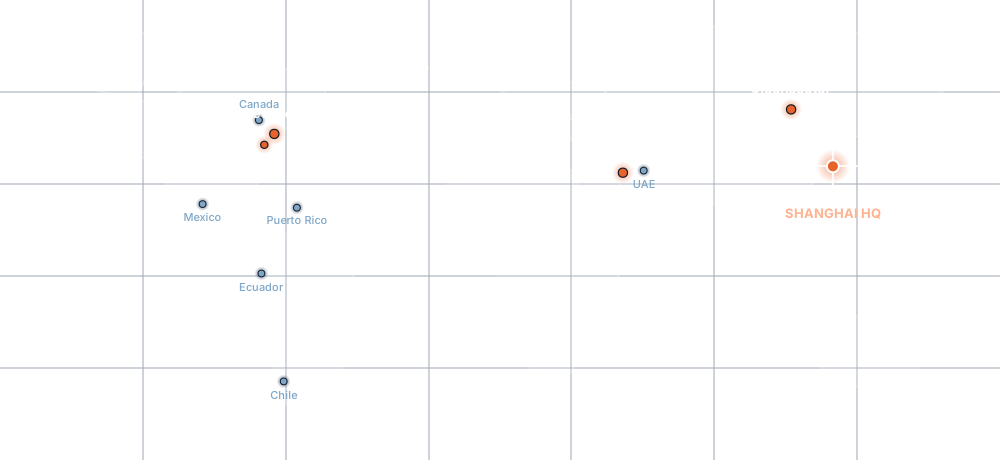
Engineering, fabrication and full seal testing at the Qingpu plant — the backbone behind every panel shipped.
New York & Virginia, USA · Ulaanbaatar, Mongolia · Kuwait City, Kuwait — documented on the project pages.
US, Canada, Puerto Rico, Mexico, Chile, Ecuador and the UAE coordinate sales, logistics and site interfaces.
China's overseas contracting qualification — the legal and process basis for every international delivery.
Send us your drawings and site conditions — receive a scope, a delivery schedule and a budget from a single contractor with six Luban Prizes behind it.