In-House Fabrication: Where Quality Becomes Physics

A curtain wall's performance is decided twice — once in engineering, again in the factory. Every unitized panel we install is machined, assembled, sealed and checked in our own Qingpu facility, under the same ISO 9001 system that governs the drawing office and the site. Owning production is not a vertical-integration slogan; it is the reason lead times and quality are predictable — the two things overseas owners buy a facade contractor for.

Capacity & Equipment

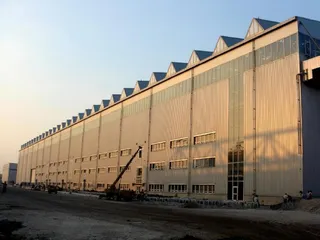
The production line behind the panels

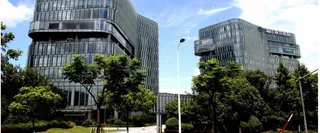
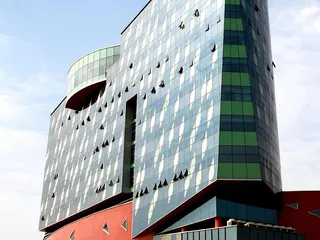
Facade with a white diamond grid and a green glazed band

Fabrication starts where engineering ends: shop drawings feed directly into the production data, so the factory machines what the engineers verified and nothing else. The line is organized in four work cells:

  1. CNC machining. Aluminum profiles are cut, drilled, routed and drained by CNC machines driven by the shop-drawing data. Corner quality, hole positions and drainage slots are repeatable to the program — not to the operator's good day.
  2. Frame assembly. Mullions, transoms and corner connectors assemble on fixtures that control squareness and twist; frame geometry is measured against tolerance before the panel proceeds.
  3. Glazing & sealing. Insulating glass is set on blocks, then glazed with structural silicone in a controlled environment. Sealant application, cure conditions and joint dimensions are logged per panel.
  4. Finish & accessory. Gaskets, caps, drainage and hardware are fitted; each panel receives its identity tag with project, position and test status.

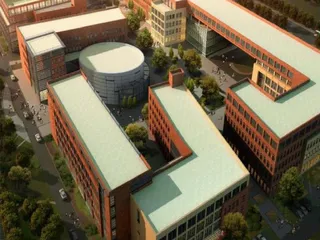
The facility at Qingpu Industrial Park — a campus that also houses our engineering and project management teams — is open to client visits, and we recommend it: see a panel being built before you buy a thousand.

Quality System

Three stages of inspection, zero surprises at handover

Incoming inspection

Glass, profiles, fasteners, gaskets and sealants are checked against the purchase specification on arrival — dimensions, coatings, edge work and documentation. A defective batch is quarantined before it can poison production; suppliers know the standard, because they are held to it consistently.

In-process inspection

Hold-and-witness points are built into the line: frame geometry after assembly, glass setting and sealant bead profile after glazing, drainage verification before sealing. Each check has a written standard; each passed panel is signed off in the production record, traceable to the operator and the day.

Final & dispatch inspection

Before dispatch, every panel passes a seal-integrity verification — the visual, dimensional and adhesion check that catches the micro-defect that would become a site leak. Beyond that, representative panels go into the water and air testing regime per GB/T 21086 to confirm the production quality matches the engineering performance. Panels that fail any check are reworked or scrapped; they do not ship.

Seal integrity and the test cabinet

Water is the facade's oldest enemy, and it attacks at the seal — the seam between glass and frame, between panel and panel. Our testing discipline has two layers:

  • Panel-level seal verification before dispatch: every unit is checked for seal continuity and adhesion at the critical joints, so a manufacturing defect is caught at the factory gate rather than on a tower at 200 m.
  • System-level performance testing on representative and project mock-up panels: static and dynamic water tests, air-permeability tests and wind-load tests per the GB/T 21086 regime, witnessed and documented for the owner's file.

This two-layer approach is the honest description of "100% seal integrity" in facade production: 100% of panels are seal-checked; performance grades are proven on tested samples under controlled conditions. We document exactly which check applied to which panel — because a quality claim without a record is just an opinion.

Aerial view of a red-brick campus with a cylindrical tower
Export & Logistics

Panels that survive 12,000 km

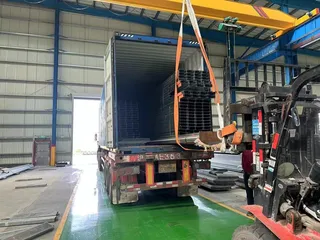
Warehouse bay with a forklift beside a truck

A unitized panel is a precision product until it is lifted; transport is where carelessness undoes factory quality. Our packaging and shipping practice treats every voyage as part of the quality system:

  • Crating. Panels are stacked on engineered racks with interlayer protection, restrained against acceleration loads, and wrapped against moisture with desiccants.
  • Container planning. Loading sequences are planned against the site erection order, so panel 1 is still the first panel out of the container at the far end.
  • Damage control. In-transit damage is inspected at loading and again at receipt; replacement designations are pre-planned so a damaged panel does not stall the program.
  • Documentation. Packing lists, inspection records and handling instructions travel with every shipment for customs and site verification.

The discipline was proven on the longest road we ship: 166 Perry Street, New York — unitized panels fabricated at Qingpu, sealed into containers, crossed the Pacific, and were erected in Manhattan to the owner's program. It is the export operation that turns "made in China" from a risk statement into a schedule statement.

The factory tour, capacity details and client-visit arrangements live on our facilities page — plan your visit through the same team that plans your panels.

Every panel that leaves the line carries the data that built it — the digital construction practice links CNC records to installed positions for full traceability.

See quality made physical — visit the factory or the drawing board.

Request the production brochure, or send your drawings and get a fabrication program with lead time and QC plan within 24 hours.