
Weather-Tight & Durable Facades — Sealed for the Life of the Building

Air permeability and water tightness are the baseline of curtain wall performance — not upgrades, not options. We design, test and deliver facade systems that meet GB/T 21086 weather-tightness grades under real wind pressures, real rain volumes and real thermal cycles, from temperate inland cities to typhoon coastlines.

The Three Baselines

Weather-tightness performance that protects the building envelope

Every curtain wall we deliver is engineered to three interlocking performance dimensions, tested on project-specific mock-ups before production release.

Air Permeability

GB/T 21086 Grade 3–4

Uncontrolled air leakage is the hidden thief of energy and comfort. We design curtain wall joints, panel interfaces and perimeter seals to achieve GB/T 21086 Grade 3 or 4 air permeability — meaning measured leakage rates of 0.5–1.5 m³/(m·h) at 10 Pa pressure differential. This is verified on every major project mock-up using calibrated fan-pressurization test rigs, not assumed from catalogue data.

The detailing discipline matters as much as the gasket quality: continuous air barriers, properly compressed seals at every interface, and quality-control checkpoints during installation that verify compression ratios in the field.

Water Tightness

GB/T 21086 Grade 4–5

Water penetration is a failure that cannot be tolerated — it damages interiors, breeds mold and erodes the structural frame behind the facade. We design to GB/T 21086 Grade 4 or 5 water tightness, with test pressures of 500–700 Pa simulating wind-driven rain at design storm intensities.

The engineering strategy is dual-barrier: a rainscreen outer plane that deflects the bulk of water, and an airtight inner gasket plane that stops what gets past the first line. Drainage channels between the two planes safely evacuate any residual water. This is not theory — it is verified on every mock-up with calibrated spray nozzles and pressure chambers.

Wind Load Resistance

3.0–5.0 kPa design pressure

The curtain wall must stay intact, sealed and deflection-controlled at the wind pressures the local code demands — and at the gust pressures typhoons actually deliver. We engineer unitized panels and stick systems for wind load resistance of 3.0–5.0 kPa, depending on project location and building height, with safety factors and connection redundancy built into the structural calculation.

Deflection limits are checked against glass supplier tolerances; connection bolts are verified for shear and pull-out; and panel-to-panel joints are designed to accommodate movement without breaking the air or water seal. Tall buildings and coastal typhoon zones get the upper end of the range — and often site-specific wind-tunnel input.

Durability Engineering

Materials and finishes that outlast the warranty

Weather tightness is only as durable as the materials that deliver it. We select finishes, metals and sealants for the specific corrosion and UV environment of each project.

Anodized aluminum

For coastal and high-humidity environments, we specify anodized aluminum profiles with film thickness ≥ 20 μm (AA20 grade). The anodic oxide layer provides a hard, corrosion-resistant barrier that withstands salt spray and atmospheric pollutants without the maintenance cycle of painted finishes. Anodizing is the standard for projects within 5 km of coastlines or in industrial atmospheres.

Fluorocarbon (PVDF) coating

For projects requiring color stability and long-term UV resistance, we apply fluorocarbon coatings with ≥ 40 μm dry film thickness and ≥ 70% PVDF resin content. This delivers 20+ year color retention and chalking resistance in even the most intense solar environments. The coating system includes a chromate conversion layer, primer and topcoat, applied in controlled factory conditions.

Stainless steel and hot-dip galvanizing

Structural connections, brackets and anchors that are hidden but load-bearing receive either hot-dip galvanizing (≥ 80 μm zinc thickness) or austenitic stainless steel (304 or 316 grade, depending on chloride exposure). These are the details that determine whether a facade survives its first decade without concealed corrosion — or fails silently behind the panels.

Structural silicone and EPDM gaskets

The sealant and gasket materials are the facade's immune system. We specify structural silicone sealants with 25-year durability ratings for structural glazing applications, and EPDM rubber gaskets with Shore A 60–70 hardness for compression seals. Both are selected for UV resistance, ozone resistance and temperature-cycle performance — verified against supplier ageing test data, not assumed.

Extreme Climate Performance

Engineered for typhoon zones and high-wind inland sites

Two airport projects demonstrate how we scale weather-tightness and durability engineering from standard performance to extreme climate demands.

Taiyuan Wusu International Airport terminal curtain wall facade

Taiyuan Wusu International Airport — high wind, extreme cold, rapid thermal cycles

Located on the Loess Plateau with winter temperatures dropping below −20°C and strong seasonal winds, the Taiyuan airport terminal demanded a facade that could maintain air and water tightness across extreme thermal expansion cycles. We delivered a unitized curtain wall system with dual-barrier water management, EPDM compression gaskets rated for −40°C flexibility, and thermal-break frames that maintain seal geometry across the full temperature swing.

The mock-up testing protocol included air permeability at design wind pressure, water tightness under 700 Pa spray pressure, and cyclic thermal testing from −30°C to +50°C to verify gasket recovery and frame movement tolerance. The facade has performed without weather-tightness incidents since completion.

View project details →

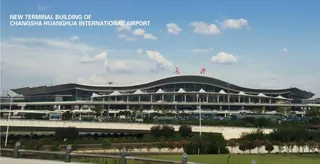
Changsha Huanghua International Airport — typhoon rainfall, humidity, summer heat

In central China's hot-humid climate with annual typhoon-season rainfall exceeding 1,500 mm, the Changsha airport terminal required Grade 5 water tightness and corrosion protection for decades of monsoon exposure. We engineered a curtain wall with enhanced drainage channel capacity, double-labyrinth gasket profiles, and anodized aluminum plus stainless-steel connections to survive the salt-laden humidity and acid rain of the region.

Wind load design accounted for typhoon gust pressures with a 1.5 safety factor on connections. The project mock-up was tested to GB/T 21086 Grade 5 water tightness at 700 Pa — the highest standard grade — with zero water penetration recorded across three consecutive test cycles. Anodized aluminum profiles were specified at AA25 grade for extended coastal-atmosphere durability.

View project details →

Changsha Huanghua International Airport terminal facade with unitized curtain wall
Performance Grades

GB/T 21086 weather-tightness grades and Hanart design targets

The Chinese national standard GB/T 21086-2007 defines five grades for air permeability and water tightness. Here is how Hanart maps these grades to real design and test parameters.

Performance parameter Grade 1 Grade 2 Grade 3 Grade 4 Grade 5
Air permeability
m³/(m·h) at 10 Pa
≤ 4.0 ≤ 2.5 ≤ 1.5 ≤ 0.5 ≤ 0.2
Water tightness
Test pressure (Pa)
250 350 500 700 1,000
Hanart typical design target — Secondary envelopes, sheltered locations Standard commercial: offices, hotels High-performance commercial, airports, landmarks Typhoon zones, extreme exposure, special requirements

Wind load resistance is not graded in GB/T 21086 but calculated per GB 50009 (Load Code) based on basic wind pressure, terrain category, building height and shape coefficient. Hanart designs unitized curtain walls for wind pressures of 3.0–5.0 kPa as standard, with higher values for coastal typhoon zones and supertall buildings validated by wind-tunnel study where required.

Get a weather-tightness specification for your climate zone.

Send your project location, wind zone and exposure conditions — receive a GB/T 21086 grade recommendation with mock-up test protocol within 24 hours.