
Company history: capability is not advertising, it is a sequence of events
Every milestone in this timeline names two things at once: the capability Hanart acquired and the project that proves it today. That is the only version of “facade company history” that matters to a building owner deciding who to trust with an envelope.
Thirty years, compressed into six decisions
The table gives the chronology; the sections below explain, for each milestone, what it allowed Hanart to do on later projects.
| Year | Milestone | Capability gained — still in service today |
|---|---|---|
| 1995 | Founded in Shanghai | Contractor-grade curtain wall delivery discipline from day one |
| 2005 | Top-50 national ranking | Organization scaled to multi-project parallel delivery with stable quality |
| 2008 | First two Luban Prizes — National Indoor Stadium, Beijing & Zhejiang Art Museum | Large-span metal roofing and sculptural stone-glass envelope engineering |
| 2009 | Three Luban Prizes — Tianjin Airbus, Taiyuan Airport, Shanghai Synchrotron | Industrial long-span roofs, airport-scale glazing, precision research envelopes |
| 2009 | Overseas contracting qualification | Legal and process basis for direct international project execution |
| 2015 | Sixth Luban Prize — Senlan International Plaza, Shanghai | Unitized curtain wall system at commercial high-rise scale |
| 2019–2026 | 7 country offices; overseas landmark delivery | Cross-border coordination for the US, Middle East and Asia-Pacific markets |
What each milestone actually bought
1995 — the founding discipline
Hanart was founded in Shanghai as a curtain wall specialist in 1995, committed from the start to executing envelopes as a contractor rather than brokering them. The founding decision — own the fabrication and the site result — is still the organizing principle of the company, and it is the reason every later milestone could be converted into repeatable capability rather than a one-off award.
2005 — the top-50 turning point
Entering China's top-50 curtain wall contractor ranking in 2005 marked the moment the company could run several landmark projects in parallel without diluting quality. Management systems, procurement standards and fabrication scheduling were formalized so that the discipline of one project could be reproduced on the next. Owners who award multi-building or phased programs benefit from this directly: the process is repeatable, not improvised.
2008 — two Luban Prizes and a new envelope type
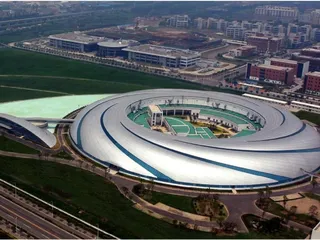
The National Indoor Stadium project in Beijing (Luban Prize 2008) tested Hanart's large-span metal roofing and facade coordination under Olympic construction deadlines. The Zhejiang Art Museum in Hangzhou (Luban Prize 2008) tested the opposite end of the craft spectrum: sculptural volumes, stone cladding and point-supported glazing with museum-grade daylight control. Together they gave the engineering team the full range from industrial precision to architectural expression.
2009 — three Luban Prizes plus the overseas ticket
Three awards in a single year — the Tianjin Airbus A320 assembly line (industrial metal roofing), Taiyuan Wusu Airport terminal (long-span roof and glazing) and the Shanghai Synchrotron Radiation Facility (precision envelope for a national research installation) — plus China's overseas contracting qualification. The qualification was the formal door; the three projects were the proof of what Hanart could already execute. The synchrotron's stability-critical envelope remains the reference for technically demanding, tolerance-sensitive work.
2015 — unitized systems at commercial scale
The sixth Luban Prize, for Senlan International Plaza in Shanghai, recognized the mature application of unitized curtain wall systems in an urban commercial context: factory-fabricated panels, fast erection in a constrained site, office-grade performance. This is the system class most overseas high-rise and tower projects specify today, and why the unitized line is central to our manufacturing strategy.
2019–2026 — from qualification to delivery network
Business offices in the United States, Canada, Puerto Rico, Mexico, Chile, Ecuador and the United Arab Emirates turned the 2009 overseas qualification into an operating delivery network. Reference projects include 166 Perry Street in New York, Grand Plaza in Ulaanbaatar and the Asian Olympic Council mansion in Kuwait. Where the company competed for its first foreign work with documents, it now delivers it with people on the ground.
The measurable outcome
Six Luban Prizes between 2008 and 2015, more than thirty provincial- and ministerial-level quality engineering awards, continuous top-50 national ranking since 2005, and export deliveries on three continents. Each is a dated, auditable event — not a claim. For the detailed award chronology, see the milestones page; for the projects themselves, the landmark index.
Your project belongs in this timeline.
Share your scheme stage and site conditions — get a perspective on system selection, fabrication and schedule from the team that built the record above.