
BIPV Solar Facade Design: Building-Integrated Photovoltaics for Net-Zero Envelopes
From crystalline silicon and thin-film BIPV modules to solar glass curtain walls — how Hanart integrates photovoltaic technology into building envelopes for energy generation and architectural aesthetics.
Published 9 October 2026 — Hanart Facade Engineering Team
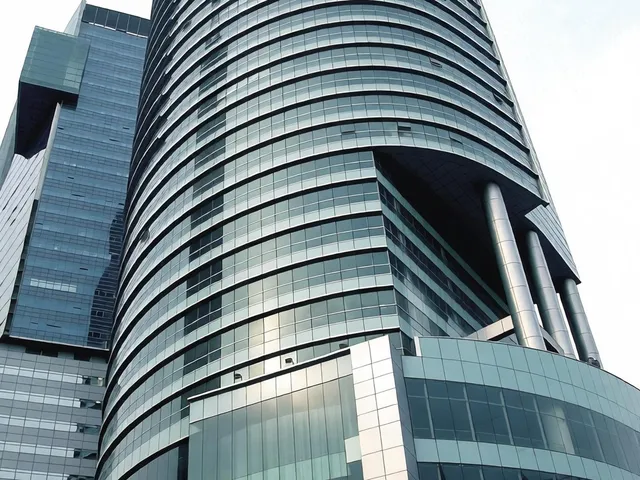
BIPV solar glass curtain wall with crystalline silicon modules integrated into a double-skin facade, combining energy generation with thermal insulation.
BIPV Technology Overview
Building-integrated photovoltaics (BIPV) replaces conventional envelope materials with photovoltaic modules that generate electricity while providing weather protection and thermal insulation. Unlike building-applied photovoltaics (BAPV), BIPV is the envelope itself — the glass, the spandrel, the skylight. This demands that PV products meet the same structural, thermal, and safety standards as conventional facade materials across a 25-year service life.
Crystalline silicon (c-Si) dominates with conversion efficiencies of 18–22 percent for monocrystalline modules, offering high power density of 180–220 Wp/m². Temperature coefficients range from -0.35 percent to -0.45 percent per degree Celsius above 25 °C, meaning a module at 65 °C loses 14–18 percent of rated output. In hot climates, this thermal penalty must be modelled accurately.
Thin-film BIPV — amorphous silicon (a-Si), cadmium telluride (CdTe), and CIGS — achieves 8–14 percent efficiency but offers superior weak-light performance and partial-shade tolerance. CdTe maintains a temperature coefficient of only -0.25 percent per degree Celsius, outperforming c-Si thermally. CIGS reaches 16–18 percent in laboratories but faces supply constraints.
Perovskite tandem cells represent the emerging frontier, with certified efficiencies exceeding 33 percent and theoretical limits near 43 percent. These can be deposited onto glass at low temperatures, enabling semi-transparent and coloured products. Stability under moisture and UV remains the primary barrier; 25-year warranty products are expected by 2028–2030. Hanart monitors commercialisation through module supplier partnerships.
Explore BIPV facade solutions for your project
Talk to a BIPV Specialist to discuss module selection, facade integration, and electrical design.
BIPV Integration in Curtain Wall Systems
Curtain walls provide the ideal substrate for BIPV because they are prefabricated, waterproof, and structurally independent. Hanart integrates BIPV into three typologies: conventional stick and unitised systems, double-skin facade cavities, and photovoltaic skylights.
Photovoltaic glass curtain walls replace conventional glazing with solar glass laminates: 6 mm tempered low-iron glass, a 1.52 mm PVB interlayer with embedded cells, and a 6 mm tempered back glass. For semi-transparent applications, cells are spaced to achieve 10–40 percent light transmittance, generating 80–140 Wp/m² depending on cell density and orientation.
Double-skin BIPV facades place modules on the outer skin of a ventilated cavity. The outer BIPV layer generates electricity while shading the inner glazing, reducing solar heat gain by 40–60 percent. The 300–800 mm cavity enables convective ventilation that cools module backs, improving efficiency by 8–12 percent versus flush-mounted installation. Automated louvres between skins permit seasonal adjustment.
Photovoltaic skylights use semi-transparent thin-film or crystalline modules as overhead glazing. Hanart employs point-supported glazing with stainless steel spider fittings and laminated solar glass with SentryGlas interlayers. Cabling routes through hollow transoms to junction boxes at floor slabs, preserving frameless aesthetics.

Double-skin BIPV facade with crystalline silicon outer modules and automated shading louvres — achieving simultaneous energy generation, solar control, and natural ventilation.
Electrical Design & Grid Connection
BIPV electrical design must reconcile photovoltaic engineering with building electrical codes, fire safety, and facade maintenance access. Hanart coordinates with MEP consultants from schematic design through commissioning.
Inverter selection depends on scale and module configuration. String inverters (3–125 kW) suit medium-sized facades with uniform orientation. Power optimisers or micro-inverters are preferred for complex geometry or partial shading, maximising harvest at the module level. Inverter efficiency should exceed 98 percent with MPPT voltage range matching module string voltage at operating temperature.
String design determines series connections for target voltage and current. For 400 Wp modules with Voc of 49.8 V, a string of 22 modules achieves 1,095 Vdc at STC — within modern inverter ranges. At 65 °C operating temperature, Voc drops to approximately 45 V per module. Sizing must account for lowest expected temperature (voltage rise) and highest expected temperature (voltage drop).
Combiner boxes and DC cabling aggregate strings with overcurrent protection. Hanart specifies IP65-rated boxes at each floor level within the cavity. DC cabling runs in dedicated conduit within hollow mullions, separated from low-voltage lines by 300 mm minimum per NEC 690. Grid connection requires bidirectional meters, export limitation controllers where required, and THD below 5 percent. Battery storage interfaces are pre-wired for future retrofit.
Thermal Performance & Building Physics
BIPV modules modify envelope thermal performance in ways that differ from conventional glazing. Understanding these interactions prevents overheating, condensation, and excessive heating loads.
Module heat gain occurs because 75–85 percent of incident radiation is absorbed or reflected, with only 15–25 percent converted to electricity. Absorbed heat raises cell temperature 20–35 °C above ambient. For a south-facing vertical BIPV curtain wall at 35 °C ambient, back-surface temperatures reach 55–70 °C. Without ventilation, this heat conducts into the building or accumulates in the cavity.
Back-ventilation is the primary mitigation. Hanart incorporates a minimum 50 mm rear gap with inlet and outlet openings for natural stack-effect ventilation. CFD modelling confirms that a 300 mm cavity with 2 percent free area achieves air velocities of 0.3–0.6 m/s, reducing back-surface temperature by 8–15 °C and recovering 5–8 percent of electrical output. In double-skin systems, mechanical extraction augments natural ventilation for extreme climates.
U-value impact. Standard BIPV laminate without low-E coating has a centre-of-glass U-value of approximately 5.7 W/m²K. Adding low-E to surface #4 reduces this to 2.8–3.2 W/m²K. Triple-glazed BIPV with two low-E coatings and argon achieves 1.4–1.8 W/m²K, comparable to high-performance conventional walls. Hanart specifies low-E BIPV glass for heating-dominated climates, accepting a 3–5 percent light transmission reduction for thermal gains.
Summer overheating mitigation extends beyond ventilation. External fixed shading reduces peak irradiance by 30–50 percent during summer afternoons. Spectrally selective coatings reflect infrared while transmitting visible light. Hanart couples energy modelling (EnergyPlus, IES VE) with electrical yield simulation (PVsyst) to optimise the balance between thermal performance and generation for each orientation.

Hanart's BIPV design documentation includes coupled thermal and electrical simulations, U-value calculations per ISO 10077-2, and PVsyst yield reports.
Structural & Safety Considerations
BIPV facades must satisfy the same structural requirements as conventional curtain walls, with additional compliance for electrical safety, lightning protection, and fire separation.
Wind and seismic loads. BIPV laminates are typically 35–45 kg/m² versus 25 kg/m² for standard 6 mm + 12A + 6 mm IGU. For a 40,000 m² facade, the additional dead load is 400–800 tonnes. Hanart's structural engineers perform FEA of bracket assemblies under combined loads per local codes. Wind tunnel testing is recommended for super-tall buildings where vortex shedding may exceed code values.
Electrical safety. BIPV systems operate at high DC voltages (up to 1,500 Vdc). Arc fault detection and interrupter (AFCI) devices are mandatory per NEC 690.9. Hanart specifies DC arc fault protection at string and array level, with rapid shutdown reducing voltage to safe levels within 30 seconds of grid disconnection. All DC cabling is double-insulated in metallic conduit within the cavity, with maintenance access at 12-metre intervals.
Lightning protection. Metal-framed curtain walls act as Faraday cages, but BIPV circuits must be bonded to the lightning protection system using 50 mm² copper conductors at 10-metre intervals. Surge protective devices protect inverter inputs against induced voltages. Isolation monitoring detects ground faults and triggers shutdown before fire risk develops.
Fire isolation is addressed through: (1) fire-rated interlayers (ionoplast or FR-PVB) preventing flame spread; (2) mineral wool cavity barriers at floor slabs; (3) smoke detection within double-skin cavities; and (4) string-level fusing and ground-fault protection limiting DC fault currents. All products are tested to IEC 61730 and UL 1703 where required.
Financial Analysis & ROI
BIPV facades carry a capital premium over conventional curtain walls, but the economic case improves when energy value, incentives, and carbon pricing are included in lifecycle analysis.
Initial investment. BIPV systems cost USD 350–650/m² installed, versus USD 180–320 for high-performance conventional walls. The USD 170–330/m² premium covers the PV laminate, inverters, cabling, and electrical engineering. For a 5,000 m² facade, incremental cost is USD 850,000–1,650,000, partially offset by replacing conventional cladding.
Energy generation. A south-facing vertical BIPV facade at 30° latitude generates approximately 900–1,200 kWh per kWp annually. For a 5,000 m² facade with 180–220 Wp/m², installed capacity is 900–1,100 kWp, yielding 810,000–1,320,000 kWh per year. At USD 0.12 per kWh, annual energy value is USD 97,200–158,400. With 0.5 percent annual degradation, 25-year lifetime revenue is USD 2.27–3.71 million.
Carbon pricing and incentives. China's ETS prices CO₂ at CNY 60–80 per tonne. A 1,000 kWp facade avoiding 600–800 tonnes CO₂ annually generates USD 4,800–8,800 per year in carbon credits. Renewable energy certificates add USD 0.005–0.02 per kWh in markets with corporate targets. Some jurisdictions offer upfront capital grants or feed-in tariffs.
Payback and ROI. Combining energy savings, carbon credits, and avoided cladding cost, Hanart projects demonstrate simple payback of 5–8 years in high-irradiance markets (Dubai, Singapore, Southern China) and 8–12 years in moderate climates. The Suzhou International Science Plaza — a 6,200 m² BIPV double-skin facade completed in 2024 — achieved simple payback of 6.8 years, with 25-year NPV of USD 1.42 million and IRR of 14.2 percent.
Hanart BIPV Project Portfolio
Hanart has engineered BIPV curtain walls across China and Southeast Asia, with expansion into the Middle East and Europe. Our design-build model covers facade engineering and photovoltaic system design under a single contract.
The Suzhou International Science Plaza (2024) features a 6,200 m² double-skin BIPV facade with monocrystalline silicon on the outer skin and low-E triple glazing on the inner. The system generates 740 MWh annually — approximately 18 percent of base electrical load — contributing 3 LEED points under EA Renewable Energy Production. Hanart provided full scope: structural analysis, thermal modelling, electrical design, module procurement from LONGi Solar, installation, and 25-year performance guarantee.
The Nanjing Green Finance Centre (2023) integrates 3,800 m² of semi-transparent CdTe BIPV glazing in the atrium skylight and south-facing curtain wall, achieving 20 percent visible transmittance while generating 285 kWp. Hanart coordinated with First Solar and JinkoSolar to deliver rapid shutdown, arc fault protection, and cloud-based SCADA monitoring. The project achieved LEED Platinum with 16 total EA points.
Supplier partnerships with LONGi Solar, JinkoSolar, Trina Solar, and First Solar ensure supply chain resilience and 25-year warranties. Module selection is project-specific: crystalline for maximum density on south facades, thin-film for diffuse-light or semi-transparent applications. Hanart's electrical engineers hold CPIA, NEC, and IEC qualifications for international projects.
FAQ
How long do BIPV modules last on a facade?
Tier-1 crystalline modules carry 25-year warranties guaranteeing 80–84 percent of rated output at end of life. Actual service life often exceeds 30 years. Hanart ensures module replacement is possible without removing adjacent panels.
Can BIPV facades match conventional thermal performance?
Yes. With low-E coatings, argon fill, warm-edge spacers, and thermally broken frames, Hanart achieves whole-wall U-values of 1.4–2.0 W/m²K — comparable to high-performance conventional systems.
What happens to excess electricity?
Excess generation is exported to the grid under net metering or feed-in tariffs. Battery storage improves self-consumption from 30–40 percent to 60–80 percent. Hanart designs all systems with BESS-ready infrastructure.
Are BIPV facades more expensive?
Upfront cost is 50–100 percent higher, but payback of 5–8 years is achievable in high-irradiance markets when energy value and carbon credits are included. For LEED Platinum or net-zero targets, BIPV is often the most cost-effective renewable path.
How does BIPV maintenance differ from standard curtain walls?
BIPV facades require standard glass cleaning (2–4 times annually) plus annual electrical inspection. Module performance is monitored remotely via SCADA. Hanart provides O&M contracts including thermal imaging to identify hot spots or faults.
- Crystalline, thin-film, and perovskite BIPV module evaluation for climate and orientation
- Structural analysis for BIPV dead load, wind, and seismic per GB 50009, ASCE 7, EN 1991
- Thermal modelling: U-value, SHGC, cavity ventilation per ISO 10077-2 and EnergyPlus
- Electrical design: inverter sizing, string configuration, DC cabling, and grid integration
- Fire safety: FR-interlayers, cavity barriers, and arc fault protection per IEC 61730
- Financial modelling: NPV, IRR, and payback with energy value and carbon credits
- Single-contract design-build with 25-year weather, structural, and electrical warranty
Request Hanart's BIPV Solar Facade Specifications
Get detailed technical data for crystalline and thin-film BIPV curtain wall systems: U-values, SHGC, electrical output, structural loads, and custom feasibility analysis.
You may also like:
Energy-Efficient Facade Engineering