
Cold-Bent Curved Glass Facades: Geometry, Stress & Practice
Cold bending curves flat glass into double-curved surfaces at installation, without a hot-bent mould — the cheapest route to free-form facades, and the one with the strictest stress discipline. This article explains how it works, where it breaks, and how the Shanghai Tower wrestled with exactly this decision.
Published 9 October 2026 — Hanart Facade Engineering Team
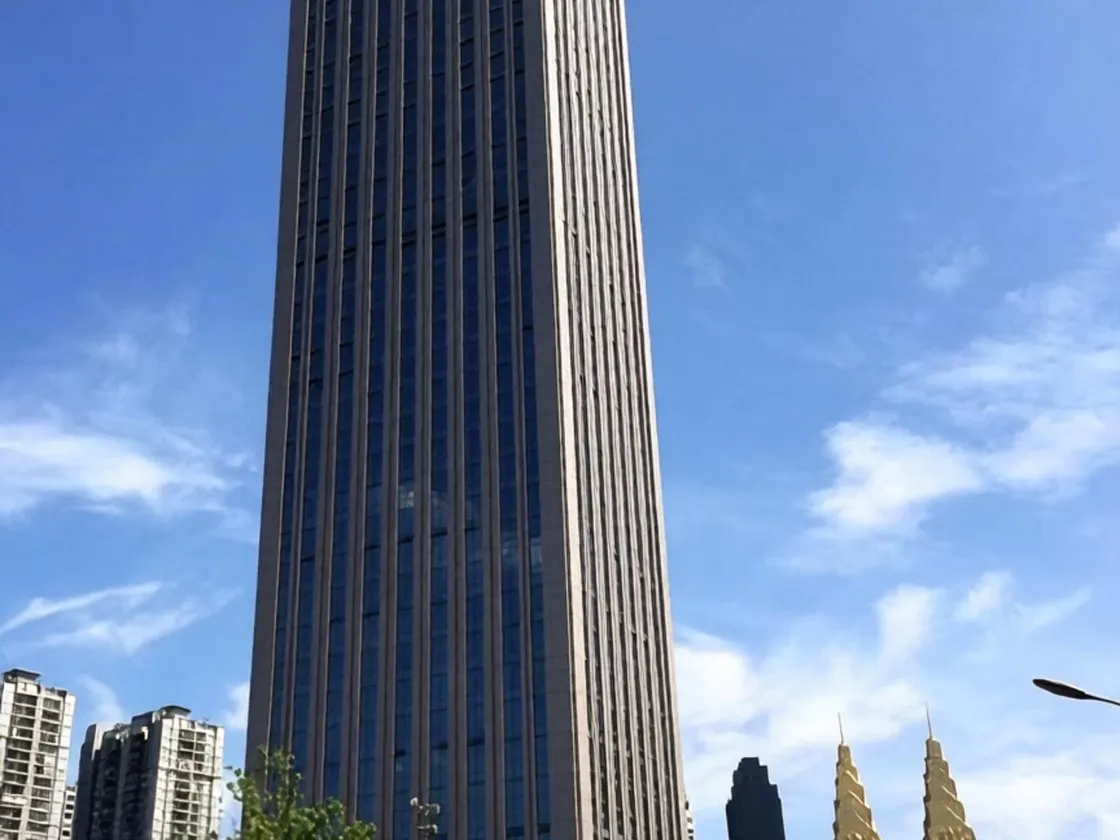
Double-curved glass reads as a single sculptural surface: cold bending achieves the geometry with flat stock, provided every panel's stress budget is verified.
Why Cold Bending Exists
Curved curtain wall construction used to mean one thing: hot bending. A flat pane is heated in a mould, sagged or pressed into the required curve, annealed, and shipped as a one-off product — with mould costs, long lead times and limited tolerance for design changes. Cold bending is the alternative: take a standard flat glass unit and elastically curve it during installation, forcing the corners into a frame geometry that turns the flat pane into a single- or double-curved surface. No mould, no furnace time, no bespoke manufacturing — the panel stays a catalogue product until the frame geometry pulls it into shape.
The economic logic is compelling. On free-form landmark envelopes, hot-bent panels can cost several times more than flat equivalents and add weeks to the programme; cold bending needs only engineered frame geometry and controlled site or factory glazing. The structural trade is equally clear: the elastic curvature is permanent stress held in the glass, so every cold-bent panel carries two load systems — the ordinary wind, snow and thermal loads of a curtain wall, plus a permanent installation-induced stress field that never relaxes.
Single Curvature vs Saddled Geometry
The mechanics of cold bending depend on the shape. A single-curved panel — bent around one axis like the arc of a cylinder — stores relatively modest stress: the glass bends primarily in one direction and the edges can be forced into a circular arc. A double-curved panel is fundamentally different. Two perpendicular bends in the same flat sheet force a saddle shape: the glass must twist as well as bend, which generates much higher stress concentrations at the corners and along diagonal lines, and is what limits practical cold-bent offset, or sagitta, to small values on large panes.
Because the achievable curvature is small — on a 2–3 metre pane, a sagitta of tens to low hundreds of millimetres depending on thickness and lite configuration — cold bending suits gentle free-form envelopes, faceted geometries and tapering towers far better than tight sculptural curves. It is also the practical route for sloped curtain wall runs and corner curtain wall transitions, where the geometry change is a gentle twist rather than a deep bend. When the architecture demands deeper curvature, the honest answer is still hot bending or segmenting the surface into smaller cold-bent panels, each with a smaller required offset.
The Stress Budget: What the Engineer Must Prove
Every cold-bent lite must satisfy the combined stress check: the permanent bending stress from installation, plus the transient stresses from extreme wind and thermal gradients, must stay below the glass allowable — with the same safety factors the code applies to ordinary glazing. The critical verification is glass-to-glass edge compression and the laminated interlayer behaviour: in a cold-bent double-glazed unit, the two lites bend together but can load each other through the spacer, and the seal must survive cyclic movement that flat IGUs never see. Engineers therefore run finite element models on every unique panel shape, check the interlayer shear in laminated cold-bent glass, and verify the perimeter seal design for the permanent strain.
Thickness is the main dial. A 6 mm lite can bend further than a 12 mm lite for the same stress, which is why cold-bent designs favour thinner glass — and why performance demands (acoustic, thermal, windborne debris) so often collide with the geometry. Where the spec needs a thick IGU and a tight radius, the panel breaks the cold-bending envelope and the design must switch tools. This is also why a cold-bent facade is never value-engineered in isolation: the panel shape, frame stiffness and glass build are one coupled system, and changing any one of them re-opens the stress case.
Connections and Movement: The Frame Side
The frame is where cold bending is won or lost. Forcing flat glass into a curve requires the perimeter frame to hold the panel in shape at the corners — the mullions, transoms and corner brackets become part of the structural system. The Shanghai Tower design studies illustrate the difficulty precisely: the team first proposed a tri-part mullion roughly 230–250 mm deep to brace long vertical spans, then moved toward custom-cast connections including cold bending of the glass to absorb geometric change, with rotational bushings designed to address thermal stresses on the girt and combined movements that could reach 114 mm cumulative at the worst location. Each iteration traded mullion depth, glass curvature and connection freedom against each other.
Rotational and sliding connections are the technical heart of the system. A cold-bent unit must be allowed to settle into its curved shape as thermal movement and wind cycles act on it; rigid corner fixings create locked-in stress concentrations and premature seal failure. The frame design therefore specifies corner articulation, load-bearing setting blocks at the correct edge positions, and enough edge clearance for the glass to flex without contacting metal. Site installation demands discipline too: units are typically cold-bent into place in a defined sequence with torque-controlled connections, and the permanent curvature makes replaceability a design criterion — a spare unit must fit the same curved frame geometry, which is why panel shapes are usually standardised even on "free-form" envelopes.
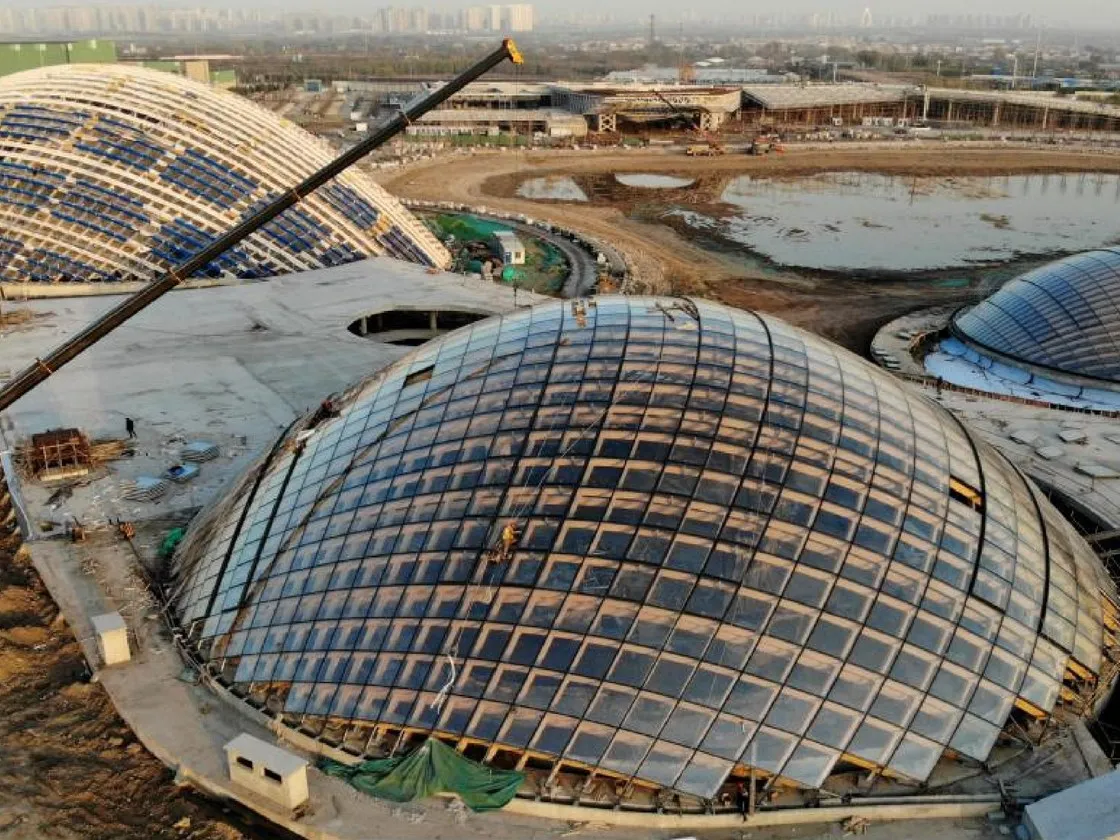
Cold-bent units are installed to a defined sequence: the frame holds the curve, so lifting, seating and torquing must be engineered like a precision assembly.
When Cold Bending Is the Right Answer — And When It Isn't
Cold bending wins in three situations: gentle double curvature on large panels where hot bending cost is prohibitive; faceted free-form envelopes where few panels share a shape; and projects on fast programmes where mould lead times kill the schedule. It loses in four: deep sagitta demanding high stress; thick or heavily coated glass that cannot take the bend; climates with extreme temperature ranges where the permanent bend plus thermal strain exhausts the budget; and critical landmark aesthetics where the client and expert panel simply prefer the certainty of hot-built geometry.
The Shanghai Tower is the instructive caution. Cold bending was proposed during the envelope studies — the process was acknowledged as "a safe procedure that is more than occasionally used in the U.S. and Europe" — yet the expert panel and ultimately the client rejected it, citing safety, installation sequence and future maintenance, and the tower was built with the staggered unitised system instead. The engineering takeaway is not that cold bending is unsafe; it is that cold-bent facades impose maintenance and replacement assumptions that landmark clients may not accept, and that the decision is made on risk appetite as much as on physics. For the wider family of curved and free-form systems, see our curved & free-form curtain walls product page; for point-supported glass that carries curves with minimal framing, point-supported glazing systems are covered separately.
Frequently Asked Questions
What is the difference between cold bent and hot bent glass?
Hot bent glass is curved in a furnace over a mould, retaining the curved shape permanently with low residual stress. Cold bent glass is elastically forced into a curve during installation — the curvature is held in place by the frame, and the glass carries a permanent installation stress. Cold bending is cheaper and faster; hot bending suits deeper and more complex curves.
How much can flat glass be cold bent?
The practical sagitta depends on panel size, thickness, lite build and the design wind and thermal budget — typically a few tens of millimetres on a standard 1.5–3 metre pane, and more on smaller lites or with thinner glass. The limit is set by the combined stress check, not by a universal number, so every unique panel shape should be verified by analysis.
Is cold bent glass safe?
When engineered and installed to spec, yes — cold bending has decades of precedent in the United States and Europe. The discipline is the same as for any glazing: a verified stress budget, proven frame connections, controlled installation and documented replacement procedures. Projects reject cold bending on maintenance or risk-appetite grounds, not because the process is unsafe.
Can cold-bent panels be replaced later?
Yes, but replacement is an engineered operation, not a swap. Because the frame holds the curvature, the spare unit must match the frame geometry exactly, and the sequence of releasing and re-seating the panel must avoid sudden stress release. This is a key design input — projects standardise panel shapes precisely to keep replacement practical.
Check Whether Your Curve Can Be Cold Bent
Send your facade geometry and glass specification. Hanart's engineers will run the stress budget, compare cold-bent versus hot-bent cost and lead time, and return a recommendation — free, within 48 hours.
You may also like:
Curtain Wall Glass Selection Guide
Point-Supported Glass & Cable-Net Facades