
Smart Glass & Electrochromic Facades: Dynamic Solar Control for Next-Generation Buildings
From electrochromic and thermochromic glazing to photovoltaic-integrated smart facades — how dynamic glass technology is redefining energy performance and occupant comfort. This article examines the four dominant smart-glass technologies, the physics of electrochromic five-layer thin-film stacks, real-world energy savings from dynamic solar control, integration pathways with building management systems, and the durability and lifecycle economics that determine whether smart glazing belongs in your next curtain wall specification.
Published 8 October 2026 — Hanart Facade Engineering Team
Advanced IGU cross-section with electrochromic thin-film stack, dual low-E coatings, and argon fill in a thermally broken aluminum frame. Dynamic tinting adjusts visible light transmittance from 60 percent to 2 percent on demand.
What Is Smart Glass in Curtain Walls?
Smart glass modulates optical properties — VLT and SHGC — in response to external stimuli. Four technologies dominate commercial facades. Electrochromic (EC) glazing uses a five-layer ceramic thin-film stack: a low-voltage DC potential drives lithium-ion migration into a tungsten-oxide layer, absorbing visible and near-infrared light. VLT ranges from 0.60 (clear) to 0.02 (dark); SHGC from 0.60 to 0.09. Switching time is 3–15 minutes. Capital cost runs USD 350–550 per square metre.
Thermochromic (TC) glazing relies on a vanadium-dioxide thin film that undergoes a temperature-driven phase transition at 25–29 °C, reducing SHGC by 0.15–0.25 without wiring. Suspended Particle Device (SPD) glazing contains rod-shaped nanoparticles that align under AC voltage for near-instant switching, but requires continuous power and offers limited clear-state VLT. Polymer-Dispersed Liquid Crystal (PDLC) glazing toggles between translucent and transparent for privacy but does not modulate SHGC, making it unsuitable for exterior solar control. For curtain wall procurement, EC glazing is the dominant choice because it simultaneously manages VLT and SHGC over a wide range and integrates with BMS architectures.
Talk to a Smart Facade Engineer
Discuss electrochromic glazing specifications, dynamic solar control integration, and BMS connectivity for your next high-performance curtain wall project.
Electrochromic Glazing: How It Works
The EC thin-film stack is deposited by magnetron sputtering and totals 2–5 micrometres in thickness. Layer 1 is an indium tin oxide (ITO) transparent conductor on the inner surface of the outer glass lite. Layer 2 is the tungsten-oxide electrochromic active layer where lithium-ion intercalation creates absorption. Layer 3 is a solid-state lithium-ion electrolyte that conducts ions while blocking electrons; moisture degradation of this layer is the dominant long-term failure mode, so manufacturers hermetically seal the stack with dual-seal edge construction rated for 25-year moisture resistance. Layer 4 is a nickel-oxide counter-electrode that stores and releases lithium ions. Layer 5 is the top transparent conductor completing the circuit.
Lithium-ion migration through the solid electrolyte is diffusion-limited. Typical switching times are 3–8 minutes for 80 percent colouration and 5–15 minutes for full bleaching. The clear-state SHGC of 0.50–0.60 drops to 0.09–0.15 in the dark state — a 4-to-6-fold reduction that is the primary energy-saving mechanism. Manufacturers including SageGlass and View Glass achieve VLT ranges of 0.60 down to 0.01–0.02 with warranties covering 10 years of switching performance and IGU seal integrity.
Energy Savings & HVAC Load Reduction
Field studies by NREL on Lawrence Berkeley National Laboratory's Molecular Foundry, which uses SageGlass on south and west facades, measured a 42 percent cooling energy reduction versus static low-E glazing (SHGC 0.35). View Glass installations report cooling load reductions of 30–60 percent, with the upper end achieved in hot climates with high window-to-wall ratios and significant west or south exposure. For a 40,000-square-metre tower with 28,000 square metres of glazing, a 40 percent cooling reduction avoids 300–500 kW of chiller capacity and saves USD 80,000–150,000 annually in electricity.
In heating-dominated climates, the dark-state penalty is modest because EC panels can clear during heating hours. Chicago climate simulations show annual heating energy increases by only 3–8 percent while cooling drops 35–50 percent, yielding net HVAC savings of 15–25 percent. Daylight harvesting adds further value: by maintaining higher VLT than heavily tinted static glazing, EC glass increases daylight autonomy, cutting electric lighting energy by 20–35 percent in perimeter zones. Combined HVAC and lighting savings typically deliver simple payback of 5–10 years for new construction.

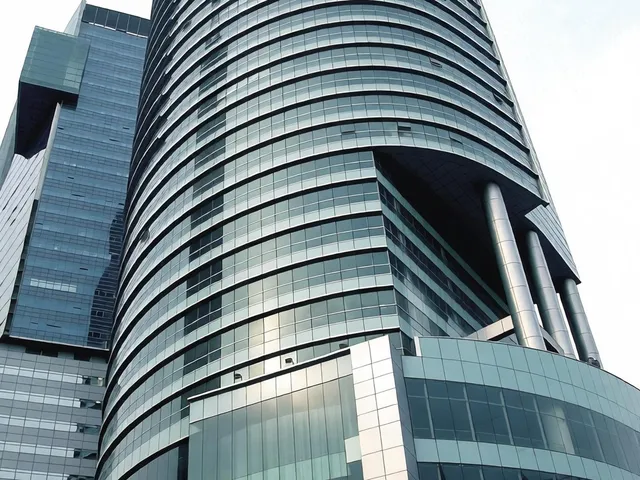
Electrochromic curtain wall on a commercial campus demonstrating graduated tinting: upper floors darken against direct solar exposure while lower floors remain clear for daylight harvesting. BMS-controlled zonal switching optimises energy and comfort simultaneously.
Integration with BMS and IoT Controls
EC glazing controllers communicate with BMS platforms via BACnet/IP, Modbus TCP, or LonWorks. Each panel or zone receives tint commands as a percentage or discrete state. The BMS executes a control sequence that coordinates facade tinting with HVAC: when west-zone panels tint to 80 percent because irradiance exceeds 600 W/m², the BMS simultaneously raises the VAV cooling setpoint, cutting fan energy. Without this coupling, the HVAC system over-cools because it does not sense the reduced solar load.
Effective control requires sensor streams from exterior pyranometers, interior illuminance photocells, air-temperature probes, and occupancy sensors. Preset scene modes include solar tracking (tint by real-time sun angle), daylight harvesting (maintain 300–500 lux), glare protection (drop to maximum tint when direct beam hits workstations), night setback (clear all panels for morning daylight), and demand response (darken all panels during utility peak events to shed 20–40 percent of building load). Zonal control divides the facade into independent orientation-based zones — south zones may run at 40 percent tint all summer while west zones cycle from 20 percent at noon to 90 percent at 16:00. This granularity requires multi-channel EC wiring confirmed with the glazing supplier during design development.
Durability, Warranty & Lifecycle Cost
Current-generation EC glazing is designed for a functional lifespan of 15–30 years. The electrochromic chemistry itself is highly reversible; the limiting factor is the hermetic edge seal that blocks moisture ingress, rated below 0.1 g/m²/day water-vapour transmission. Standard warranties cover 10 years for switching performance and IGU seal. Exclusions include physical damage, overvoltage, ammonia-based cleaning chemicals, and unauthorised disassembly.
A 20-year lifecycle comparison for 28,000 square metres of glazing illustrates the economics. Electrochromic first cost at USD 450/m² totals USD 12.60 million versus USD 3.36 million for standard double low-E at USD 120/m² — a USD 9.24 million premium. Annual HVAC and lighting savings at USD 0.12/kWh average rate run USD 185,000 per year. Present value of 20-year savings at 5 percent discount is USD 2.31 million. Net present cost remains negative under standard rates, which is why EC glazing is most common in premium buildings where occupant comfort, daylight quality, and green certification carry value beyond pure energy payback. In markets with electricity above USD 0.20/kWh or strong demand-response incentives, the financial case improves substantially. Replacement is panel-by-panel but requires electrical disconnection; owners should specify a 2–5 percent spare-panel inventory at handover for rapid swap-out.

Hanart's smart facade documentation package includes electrochromic glazing performance certificates, IGU seal warranty terms, BMS integration specifications, and 20-year lifecycle cost models for client review.
Photovoltaic-Integrated Smart Facades
The next frontier combines dynamic solar control with on-site generation. In a typical BIPV + EC hybrid configuration, an amorphous silicon thin-film photovoltaic layer is deposited on the outer lite (surface #2) while the electrochromic stack sits on the inner lite (surface #4), separated by an argon-filled cavity. The partially transparent a-Si layer generates 50–100 W per square metre at 6–10 percent efficiency while the EC layer manages heat and daylight.
For a 40,000-square-metre facade with 20 percent hybrid glazing area, annual generation is 140–280 MWh, offsetting 3–6 percent of total building electricity. Back-ventilated spandrel cavities keep IGU temperatures below 55 °C even under 1,000 W/m² solar load, protecting the EC thin-film stack. Perovskite semi-transparent cells promise 15–20 percent efficiency but still lack 20-year facade warranties; Hanart monitors validated perovskite developments through our R&D network for future integration when durability standards are met.
Hanart's Smart Facade Integration Capability
Hanart integrates EC, TC, and BIPV glazing into unitised and stick-built curtain wall systems. We do not manufacture the glass; we engineer the system that makes it perform. Our supplier relationships with SageGlass and View Glass allow us to coordinate glass dimensions, edge-deletion zones, bus-bar placement, and wire routing through thermally broken frames without compromising pressure-plate engagement or thermal performance.
Each smart facade project receives a Smart Facade Integration Package including: EC panel schedule with electrical zoning; frame cross-sections showing wire routing through mullion cavities; BMS control sequence with tint setpoints and alarm logic; commissioning protocol with uniformity acceptance criteria (delta E less than 3 per zone); and O&M manual with cleaning restrictions and inspection intervals. Our simulation team models the facade in IES VE or EnergyPlus with custom EMS scripts that replicate EC tinting as a function of irradiance and BMS logic, outputting annual energy savings and daylight autonomy metrics for LEED or net-zero targets. Post-installation, we validate with pyranometers, illuminance meters, and thermal cameras to confirm performance within 10 percent of the model.
Current projects in development include a 55-storey Southeast Asian tower with 18,000 square metres of SageGlass EC glazing, a Middle East research building combining View Glass with automated venetian blinds in a double-skin cavity, and a net-zero East Asian office pavilion with BIPV-EC hybrid spandrels. These span hot-humid, hot-arid, and mixed climates, demonstrating smart facade adaptability across global contexts.
- Electrochromic glazing integration with SageGlass, View Glass, and licensed suppliers
- Custom frame design with wire routing through thermally broken mullions and pressure plates
- BMS control sequence development with sensor zoning and demand-response integration
- Annual energy simulation with EMS-based EC tinting logic in IES VE and EnergyPlus
- Daylight autonomy and glare analysis coupled with dynamic solar control
- Field performance validation with pyranometer, illuminance, and thermal imaging verification
- BIPV-EC hybrid spandrel design with back-ventilated cavity and grid interconnection coordination
- LEED and net-zero compliance documentation for EA, EQ, and renewable energy credits
Frequently Asked Questions
Can electrochromic glazing be retrofitted into an existing curtain wall?
Retrofit is possible but more complex than new construction. Existing IGUs are replaced with EC units, and electrical wiring must be routed through existing mullions or surface-mounted with conduit. Costs run 1.5–2.5 times new-construction rates per square metre. Hanart evaluates feasibility through a site survey of frame geometry and electrical accessibility.
What happens to electrochromic glazing during a power outage?
EC glass remains stable in its last commanded state without power — it does not revert to opaque like SPD or PDLC. Some controllers include battery backup to execute a programmed safe state (moderate tint) during extended outages.
How does electrochromic glazing affect wireless signal transmission?
The conductive TCO layers can attenuate RF signals by 5–15 dB. High-EC-ratio buildings should model Wi-Fi and cellular coverage with EC attenuation included, using distributed antenna systems or perimeter access points as needed. Hanart coordinates with technology consultants during design development.
What cleaning and maintenance does electrochromic glazing require?
Clean with mild detergent and deionised water; avoid ammonia-based products that corrode edge bus bars. Inspect electrical connections every 5 years and update controller firmware annually. No moving parts mean maintenance is minimal beyond cleaning and electrical checks.
Is thermochromic glazing a viable alternative to electrochromic for climate-responsive facades?
TC glazing works well in consistently hot climates where its fixed transition temperature (25–29 °C) aligns with cooling demand. It is maintenance-free and lower cost (USD 180–280 per square metre) but cannot be actively controlled for season or daily variation. EC glazing is preferred where BMS integration, zonal control, and year-round optimisation are required.
Request Electrochromic Glass Specifications
Get project-specific smart glazing specifications, energy simulation reports, BMS integration drawings, and lifecycle cost analysis from Hanart's facade engineering team.
You may also like:
LEED & Energy Efficiency in Curtain Wall Design