
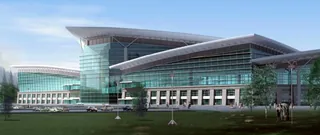
Luban Prize 2009 · New Terminal
Taiyuan Airport Terminal
Long-span terminal roof and glazing delivered around a drainage philosophy — an envelope engineered to move passengers and rain for decades.
Read case study →An airport terminal is the most demanding exam in the facade business: enormous envelope areas, tolerances measured in millimeters across huge spans, passenger flows that cannot stop, and an operator with zero tolerance for leaks or maintenance access. The terminal record below shows how Hanart writes speed, precision and drainage into the envelope.
Start with scale. A terminal envelope covers huge roof and wall areas, which sounds like an opportunity until you realize what scale does to failure: a single small leak at a gutter detail, a single panel tolerance error in a long facade run, becomes an operational event repeated across hundreds of similar details. Airports are also movement machines — the steel roof structure expands, the glazing wall has to breathe with it, and curtain wall modules manufactured and installed in sequence over many months must meet dimensional standards that would be acceptable anywhere else but unforgivable in a security and passenger-flow environment.
The operational constraint is what separates airport work from every other typology. A terminal does not shut down so you can fix the envelope. There is no quiet season for rework, no empty wing for scaffolding, and every repair above a check-in hall or an airside corridor is coordinated with airport operations, security and flight schedules. The discipline that controls this risk is design-stage: drainage validated before fabrication, tolerances distributed across the facade run early, interface details agreed with the roof and the slab before panels start arriving on site. In airport work, the engineering you do before the first drawing release is the maintenance you never have to do after handover.
The two projects below represent the two ways Chinese airports grow: new-build terminal delivery (Taiyuan, honored with a Luban Prize in 2009) and live-terminal expansion (Changsha Huanghua), where the envelope had to be installed around an operating airport with phased handover. Together they demonstrate the range an owner needs when choosing a facade contractor for a transport facility — the ability to deliver a landmark terminal from scratch and the ability to thread a new envelope through an airport that never stops.
Long-span terminal roof and glazing delivered around a drainage philosophy — an envelope engineered to move passengers and rain for decades.
Read case study →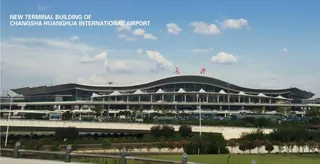
Terminal curtain wall delivered as a phased expansion of an operating airport — operational interfaces and handover sequences that kept flights moving.
Read case study →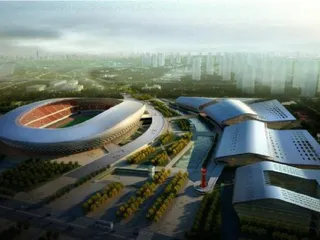
Standing-seam roof engineering for huge spans: drainage path validation, wind uplift zoning and thermal movement absorption — the system behind both terminals.
Explore the system →| Parameter | Design driver | Hanart approach |
|---|---|---|
| Envelope scale | Huge roof and wall areas amplify any defect | Standardized module designs with centralized tolerance distribution across long runs |
| Roof drainage | Large collecting areas; no tolerance for interior leaks | Validated drainage paths, overflow provisions and maintenance-accessible details |
| Wind uplift | Terminal roof zones with high negative pressures | Zone-specific clip and fastener engineering verified at system level |
| Thermal movement | Long-span steel frames move with climate and load | Movement joints matched to frame displacement analysis |
| Operational interfaces | Live airport: security, passenger flows, phased handover | Installation sequences coordinated with airport operations; phase-by-phase handover |
| Contract model | Single-responsibility for roof-facade interface risk | One engineering-fabrication-installation team from gutter to glazing |
The Taiyuan Airport terminal received its Luban Prize in 2009 — the same year Hanart earned national honors on an industrial roof, an airport and a research facility, a combination that no single-typology contractor can claim. What the airport record demonstrates specifically is consistency under operational constraint: the Changsha expansion, delivered without a prize, demanded the harder discipline of installing a new envelope inside a working airport under phased handover.
For an owner or operator planning a terminal project, the selection question is not whether a contractor can build a big facade. It is whether the contractor's roof engineers, facade engineers and site managers are the same organization from gutter to glazing, so drainage, tolerance and operations planning cannot fall between subcontractors. That is Hanart's structure, and it is why the airport series — from the Luban-winning terminal to the live expansion — reads as one method applied twice. To test it against your scope, send your drawings for a proposal within 24 hours.
Send your drawings for a free facade proposal within 24 hours — airport-scale curtain walls and roofs with zero tolerance for leaks.