
Project
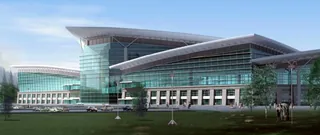
Taiyuan Airport Terminal
The airport counterpart — large-span envelope honored with the 2009 Luban Prize.
Read →A growing hub wrapped in new envelope while the airport never stopped flying — stick-built glass and unitized modules delivered at speed and at precision in a hot, humid climate.
Changsha Huanghua International Airport has grown with one of the fastest-rising urban economies in central China, and its terminal expansion program turned the airport into a construction site that could not be allowed to behave like one. Unlike a greenfield terminal project, the expansion wrapped new capacity around a facility that continued flight operations throughout — new terminal and pier spaces rising beside live gates, handling and ground traffic — which imposed a discipline on every envelope trade that few buildings ever face: the facade work had to be engineered, scheduled and executed without a single disruption to airport operation, at every hour of every day.
Hanart's envelope scope spanned the terminal expansion: curtain wall systems sized and detailed for a large public building — the stick-built glass construction and unitized module families that airports favor for speed and repeatability — together with the roofing and interface work where the new envelope met the existing terminal. The performance agenda was set by Changsha's climate, one of China's more demanding for facades: hot, humid summers with intense solar gain; significant rainfall; and year-round condensation pressure in a subtropical regime. The glazing, framing, ventilation strategy and thermal design all had to be engineered for that regime, not merely specified against it.
The project's significance for Hanart's record is operational as much as technical: the expansion proved that the company's envelope systems and installation management perform inside the constraints of a live airport environment — the environment most airport authorities are actually building in. It stands alongside Taiyuan as the airport pairing in the transport collection, the demonstrated answer and the award-winning answer together.
The site is the airport. The terminal expansion lifted envelopes directly adjacent to live operations: passenger flows, ground vehicles, aircraft movement and security zones all continued around the construction. Every crane swing, every delivery movement, every hoist zone had to be coordinated with airport protocols; work windows were pinned to operational constraints; and the envelope had to be closed in weathertight increments so that the construction zone never compromised the controlled environment of the operating terminal. The discipline that separates a facade contractor for airport work is precisely this: the ability to execute the same system quality inside a live-airport movement plan.
Humidity is the enemy. Changsha's subtropical climate loads the envelope with solar gain, high dew points and sustained rainfall. The facade engineering therefore concentrated on the three failure modes of the hot-humid regime: solar heat gain driving cooling load in the passenger environment, condensation management at the envelope's surfaces and frames, and water tightness under intense, wind-driven rain. Glazing packages were tuned by orientation, thermal-break framing was engineered consistently through the system, and drainage was detailed with the margins that monsoon-intensity rainfall demands — details that are invisible in the finished terminal and essential in its first humid summer.
Expansion means interfaces with the existing. A terminal expansion is not a clean standalone envelope; it meets the existing terminal at floors, roofs and shared structural conditions that were never designed for the new construction. The expansion work required interface engineering with real field uncertainty — surveying conditions on site, rationalizing new and old systems, and detailing the movement and weatherproofing at the join so the expanded building behaves as one terminal. This is the daily reality of airport capacity programs worldwide, and the core of the experience Hanart brings to airport authorities working on growth, not just on new builds.
The envelope combined the construction families an airport expansion needs. Curtain wall — stick-built where site geometry and phasing favored sequential installation — delivered the terminal's daylight and public-space glazing with thermal-break framing engineered for the hot-humid regime and glazing tuned by orientation. Unitized modules were applied where the program favored shop fabrication: repeatable, fast-to-install panels with the quality and tolerance advantages of factory production, arriving on a schedule that fit the airport's operational windows. Together the systems covered the terminal's envelope with one engineering standard, detailed on the unitized system page.
The climate agenda governed the details. Solar-control glazing was specified and positioned to manage Changsha's high solar load — shading the passenger environment while admitting the daylight that defines a modern terminal. Condensation strategy was engineered at the framing and glazing system, not left to interior materials, because a humid subtropical airport tests every thermal bridge. Drainage and water tightness were designed and tested for intense rainfall, with joints and gaskets selected for the temperature extremes of central China. Fabrication, QC and delivery were scheduled against the airport's ground movement and work-window restrictions — the production discipline that turned a demanding site into a deliverable project.
Handed over on a working airport's schedule, the Changsha expansion stands in the portfolio as the operational proof point: Hanart envelope systems, delivered at speed and precision around live operations, engineered for the hot-humid regime. Airport authorities planning growth programs can review the full airport and transport collection, compare the Luban-winning Taiyuan terminal, and discuss their own constraints with the team directly.
| Parameter | Detail |
|---|---|
| Project | Changsha Huanghua International Airport — terminal expansion |
| Envelope scope | Curtain wall (stick-built) + unitized modules + roofing and interface work |
| Delivery condition | Full envelope executed around live airport operations — zero disruption |
| Climate design | Hot-humid subtropical: solar control, condensation strategy, monsoon-grade drainage |
| Glazing strategy | Orientation-tuned solar control; thermal-break framing throughout |
| System mix | Stick-built curtain wall + unitized modules chosen for speed and repeatability |
| Standards | ISO 9001 / 14001 / 45001 management systems; GB/T 21086 performance testing |
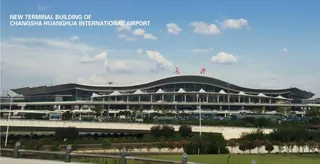
New envelope rising beside a terminal that never stopped operating.
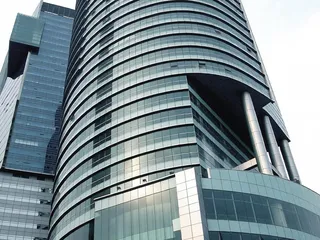
Daylight engineering for bright, humid skies with shading for the passenger.
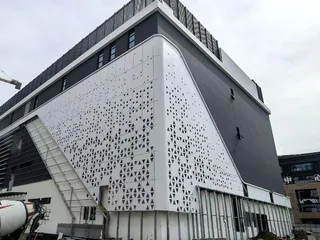
Where the new envelope joins the existing terminal as one building.
The airport counterpart — large-span envelope honored with the 2009 Luban Prize.
Read →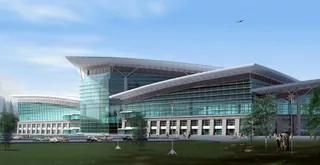
The transport portfolio — hubs, terminals and stations at every scale.
Browse →
The module system that brought shop precision to the airport's schedule.
Explore →Request a similar quote — envelope systems engineered to deliver around your operations, not despite them.