Commercial Tower Facades — Unitized Glass for High-Rise

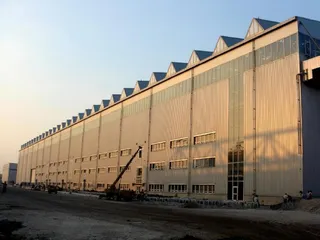
The taller the building, the stronger the case for factory-made panels. Hanart's commercial portfolio pairs unitized curtain wall systems with fast, weather-independent site erection — from Shanghai's Senlan International Plaza to export towers in New York.

  • Luban Prize 2015
  • Unitized Systems
  • High-Rise Delivery
Why Towers Favor Unitized Systems

Every additional floor increases the factory advantage

High-rise commercial construction multiplies every facade risk by the number of floors, and that arithmetic is exactly what favors unitized construction. When panels are assembled horizontally in a factory — framing, glazing, sealant and gaskets applied at bench height under controlled conditions — the two variables that destroy tower schedules disappear from the critical path: weather and skilled-labor availability at height. A unitized panel arrives on the roof hoist as a finished, tested module with its structural silicone cured in the factory, not on a scaffold in a rain shower forty floors up.

The second advantage is speed measured per floor cycle. Unitized erection follows the structure up the tower in a rhythm measured in days per floor, which matters twice over in a commercial project: rental income starts at shell completion, and a shorter facade duration shrinks the interface window with every other trade. The third advantage is quality consistency. Fabrication in Hanart's own Qingpu factory means every panel passes the same cutting, assembly, sealant and inspection sequence — the same measured tolerances apply to panel 1 and panel 2,000, which is how a six-time Luban Prize-winning organization controls what happens above a city street.

The commercial record below spans both ends of the delivery chain: a downtown Shanghai complex honored with the Luban Prize, and a glass tower exported from the same factory to New York. That is the practical definition of a system that travels — the unitized discipline does not change when the address changes, only the logistics and code coordination around it.

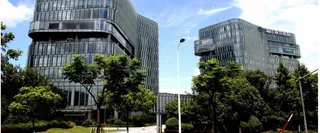
Senlan International Plaza unitized facade, Shanghai
Luban Prize 2015 · Shanghai

Senlan International Plaza

Factory-fabricated unitized panels and fast erection on a constrained Pudong site — Hanart's sixth Luban Prize, awarded for commercial delivery.

Scale profile · Multi-tower mixed-use campus, Pudong

Read case study →
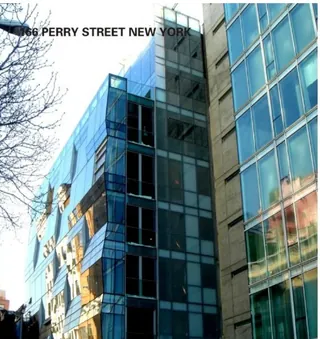
166 Perry Street glass tower under coordination, New York
Export · New York

166 Perry Street, New York

A unitized glass tower envelope delivered from Qingpu to Manhattan — land-side logistics, US coordination and the same factory quality, twelve time zones away.

Scale profile · Slim high-rise glass tower, West Village

Read case study →
Parameters That Matter

What an office tower owner should specify

Parameter Design driver Hanart approach
System type Height, floor cycle target, site constraints Unitized panels recommended for high-rise; stick-built for low-rise or complex geometry
Glazing strategy Solar loads, office comfort, energy targets Low-E insulating glass units sized to orientation and climate zone
Erection speed Rental income starts at shell completion Floor-cycle planning and factory-precured panels remove weather from the critical path
Consistency Quality across thousands of panels Single-factory fabrication with standardized inspection at every production stage
Water & air performance Wind-driven rain at height; energy leakage Seal integrity tested at module level; performance verified to GB/T 21086 testing
Contract model Interface risk across design, fabrication and site One contractor from shop drawings to handover; single responsibility for the envelope
Tower Scale & Delivery Record

High-rise work, documented by scale and delivery model

Commercial towers are compared by physical scale and by how the envelope is made and delivered. The record below sets out both parameters for Hanart's tower portfolio — using the scale and delivery facts the projects actually established.

Height alone is a weak procurement metric: two towers of similar height place completely different demands on a facade depending on tower geometry, floor plate, wind exposure and delivery model. What an owner should benchmark instead is the scale profile — how tall and slender the building is, how the envelope repeats across elevations — and the delivery model, which determines whether the facade can be engineered, fabricated and installed to tower tolerances at all. Hanart records both for every commercial project, and publishes height or area figures only when they come from a source the company can stand behind; where such figures are not in the verified record, the scale profile stands in their place.

The two projects below bookend the commercial record: a Luban-winning multi-tower campus delivered at home in Shanghai, and a slim high-rise glass tower built to US standards from the same Shanghai factory. Both are unitized envelopes — the system family engineered precisely because it scales: shop-made modules, floor-cycle speed and factory-controlled quality are what make hundreds of storeys of facade deliverable.

Project Scale profile Envelope system Delivery model Recognition
Senlan International Plaza Multi-tower mixed-use campus, Pudong Unitized curtain wall Shop-fabricated modules, crane-installed across multiple towers Luban Prize 2015
166 Perry Street, New York Slim high-rise glass tower, West Village Unitized curtain wall Engineered and fabricated in Shanghai, exported and installed in New York ASTM-based validation
Portfolio Across Markets

The same panels, from Pudong to Manhattan

Commercial towers are the most repeatable envelope problem in the facade business, which makes them the best test of a contractor's production system. The Senlan Plaza case shows the system at its home base — a downtown Chinese megacity site where space for staging was scarce, delivery windows were tight and the answer was factory-made modules. The Perry Street case shows the same system exported: panels built in Qingpu, shipped across the Pacific and erected in New York under US project coordination, which is the level of logistics capability an owner needs when the factory is on the other side of the world.

Whether your tower will be built in Shanghai, New York or anywhere in between, the commercial portfolio answers the same evaluation question: does this contractor's unitized system hold tolerance, speed and quality when replicated across thousands of panels and hundreds of floors? The evidence is in the Senlan case study and the Perry Street export record, with the unitized system page explaining the construction. To test the fit for your tower, send your drawings and get a proposal within 24 hours.

Building a high-rise commercial envelope?

Send your drawings for a free facade proposal within 24 hours — unitized systems engineered, fabricated and installed to office-tower performance.