
BIPV Solar Facade Case Library
The system page tells you what Hanart can build. This library records what Hanart has already delivered: installed BIPV envelopes with measured generation, verified certification contributions and the engineering decisions behind each project.
Evidence, not renderings
Every entry below is a delivered project whose figures come from the project record already published on this site — the same records that back the LEED cases page and the green product series. Where a number is a tested or monitored value, the page says so; where a figure is an estimate, it is labelled as one. The library is refreshed as projects close out, and every record links to its factual reference.
Two delivered BIPV envelopes form the current evidence base: a monocrystalline double-skin facade in Suzhou and a semi-transparent CdTe installation in Nanjing. Together they cover the two technology families Hanart integrates — crystalline modules for high power density and thin-film glass for daylighting — and the two most common business cases: energy-led new build and certification-led commercial retrofit.
Suzhou International Science Plaza
Hanart held the full scope of a 6,200 m² double-skin BIPV facade: structural analysis, thermal modelling, electrical design, module procurement from LONGi Solar, installation and a 25-year performance guarantee.
- Envelope. Monocrystalline silicon photovoltaic modules on the outer skin, low-E triple glazing on the inner skin.
- Output. 740 MWh generated per year — about 18 percent of base electrical load.
- Certification. 3 LEED points under EA Renewable Energy Production.
- Economics. Simple payback of 6.8 years on a 25-year NPV of USD 1.42 million.
Because engineering, fabrication and installation sat under one contract, the yield model, the structural section and the electrical layout were designed as one system rather than three hand-offs. The double-skin cavity vents heat behind the PV modules, which keeps operating temperature lower and protects yield through the cooling season.
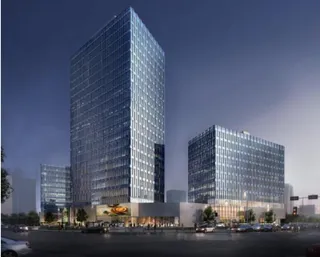
Nanjing Green Finance Centre
Semi-transparent CdTe BIPV glazing across 3,800 m² of atrium skylight and south-facing curtain wall, delivering 285 kWp while holding 20 percent visible transmittance for occupant daylight.
- Modules. Thin-film CdTe coordinated with First Solar and JinkoSolar for supply and electrical integration.
- Safety. Rapid shutdown, arc-fault protection and cloud SCADA monitoring engineered into the envelope.
- Certification. LEED Platinum with 16 total EA points — evidence that power-generating envelopes and daylight can coexist.
- Design intent. 20 percent visible transmittance balanced daylight autonomy against generation area.
The project demonstrates the thin-film route for buildings where daylight matters more than peak power density. CdTe modules accept partial transparency in ways crystalline cells cannot, so the envelope generates electricity across zones that would otherwise be static spandrel and skylight area.
The two delivered records at a glance
| Project | Envelope | PV technology | Output | Certification | Payback |
|---|---|---|---|---|---|
| Suzhou International Science Plaza (2024) | 6,200 m² double-skin facade | Monocrystalline silicon (LONGi) | 740 MWh/yr · 18% of base load | 3 LEED EA points | 6.8 years |
| Nanjing Green Finance Centre (2023) | 3,800 m² glazing: atrium + south facade | Semi-transparent CdTe (First Solar / JinkoSolar) | 285 kWp · 20% visible transmittance | LEED Platinum · 16 EA points | Returns with certification value |
Both records are published as part of the site’s LEED evidence set; system capabilities are documented on the BIPV solar facade product page.
A number on this page is a tested number
BIPV performance claims follow the same verification path as every Hanart facade: unitized panels are sprayed and pressure-cycled in the plant test cabinet, mock-up thermography runs before fabrication begins, and module output is monitored by SCADA against the 25-year performance guarantee. Environmental declarations for framing, glass and sealants are prepared to ISO 14025 / EN 15804 and support certification documentation.
- Plant-level watertightness and wind-load testing of PV assemblies
- Mock-up thermography and electrical layout review before fabrication
- SCADA monitoring against a 25-year performance guarantee
- EPD documentation for materials used in the envelope
Technical files — PV integration details, electrical diagrams, yield calculations and commissioning guides — are available from the BIPV technical downloads page.

Questions owners ask about BIPV evidence
The product page explains what Hanart can build: system types, performance ranges and engineering process. This library records what Hanart has already delivered, with measured output, certification contributions and payback from completed projects.
From the project records already published on this site, including the LEED cases page and the green product series. Every figure on this library is traceable to that factual reference record.
Completed BIPV envelopes are monitored through SCADA against a 25-year performance guarantee. Plant-level watertightness and wind-load testing, mock-up thermography and commissioning records are kept for each project.
Yes. BIPV panels are one of the common energy-retrofit routes on existing envelopes. The existing facade retrofit service covers audit, design and installation, and BIPV modules are among the products it can specify.
Send drawings, orientation and energy targets through the RFI form. You receive solar yield modelling, system cost, payback and incentive eligibility mapped to your specific climate.
Add your building to the next verified record
Send us your drawings and energy targets for a BIPV feasibility study — modelled yield, system cost, payback and incentive eligibility.