
Tempered vs Heat-Strengthened vs Laminated Glass: An Engineering Comparison
Tempered, heat-strengthened and laminated glass are routinely lumped together as “safety glass” — but they fracture differently, carry different strength ratings and answer to different failure modes. This is the engineering comparison specifiers need before signing a glass schedule.
Published 9 October 2026 — Hanart Facade Engineering Team
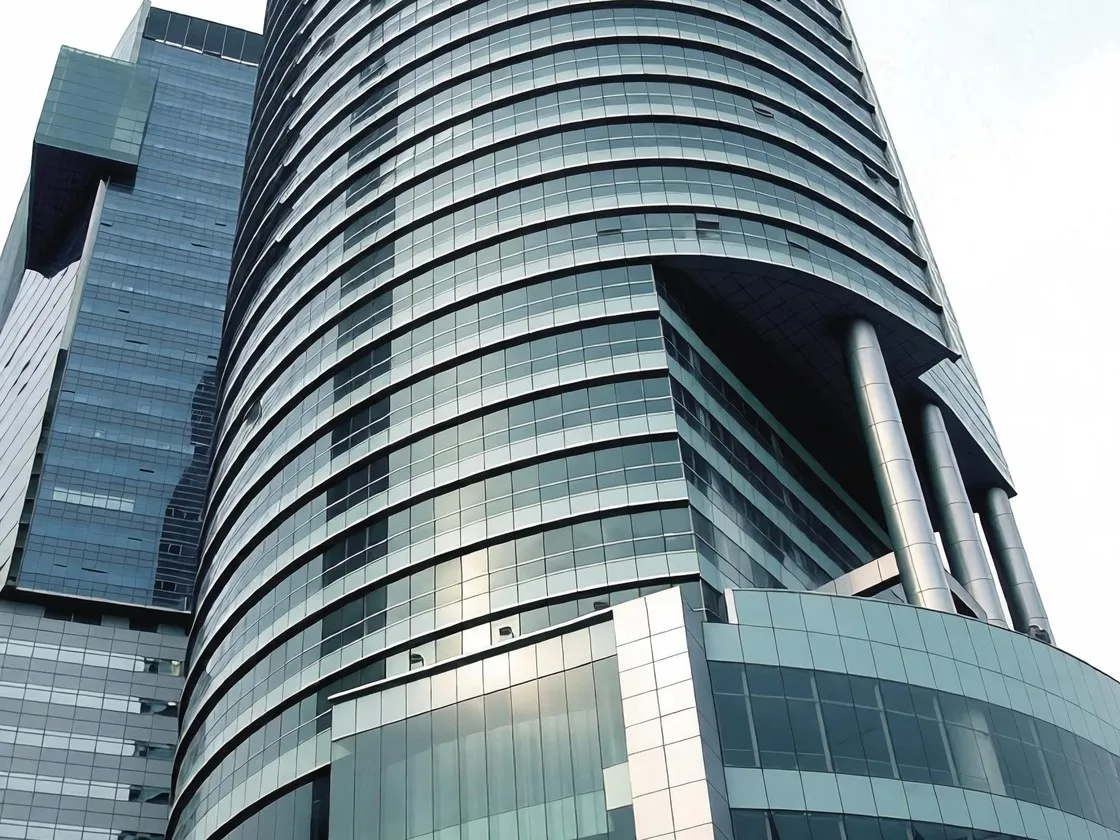
Most curtain-wall glass is a composite: tempered or heat-strengthened outer panes paired with a laminated inner pane. Understanding each layer is the first step to a correct spec.
Fracture Behaviour Is the Difference That Matters
The three terms describe heat treatment and lamination, not glass chemistry \u2014 the base glass is the same float product. What changes is how the glass stores stress and what happens when it breaks. A fully tempered pane is heated and rapidly quenched so its surfaces are in compression and its core in tension: it is about four to five times stronger in bending than annealed glass, and when it fails it disintegrates into small blunt dice-like fragments. A heat-strengthened pane gets the same treatment at a lower quench rate: roughly two times the strength of annealed glass, but on failure it breaks into large shards that stay largely in place. A laminated pane is two or more glass layers bonded by an interlayer (typically PVB or SGP): when it breaks, the interlayer holds the fragments attached to the frame, keeping a barrier in place even after impact.
These three behaviours answer three different questions. Tempered glass answers \u201chow do I get strength with safe small fragments?\u201d Heat-strengthened answers \u201chow do I get moderate strength without total disintegration?\u201d Lamination answers \u201chow do I keep the opening closed after breakage?\u201d The best curtain-wall specifications combine them \u2014 which is precisely why most high-performance curtain-wall glass is an insulated unit with a heat-treated outer pane and a laminated inner pane.
Fully Tempered (Toughened) Glass: Strength with Disintegration
Fully tempered glass is the workhorse of facades, balustrades and doors. Its surface compression of roughly 90\u2013130 MPa gives it four to five times the bending strength of annealed glass, plus high resistance to thermal stress and moderate impact. In most jurisdictions, tempered glass above a size threshold is legally required in overhead glazing, doors and areas where people can fall against the glass \u2014 the small-fragment fracture pattern is the point: it reduces laceration risk.
The trade-offs are real. First, spontaneous breakage: nickel-sulfide inclusions can cause a tempered pane to shatter without warning, statistically rare (roughly one in every 15,000\u201330,000 panes) but impossible to eliminate entirely; heat-soak testing in the factory reduces \u2014 not removes \u2014 the risk. Second, no post-cutting or drilling: all fabrication happens before tempering. Third, edge vulnerability: because the surface is prestressed, edge and corner damage can trigger full disintegration \u2014 the reason transport and site-handling protocols matter as much as the spec itself. For facade use, tempered glass as a single pane is strong but brittle in failure mode; that is why it is usually paired with lamination rather than used alone in critical locations.
Heat-Strengthened Glass: The Facade's Quiet Workhorse
Heat-strengthened glass sits between annealed and fully tempered: surface compression of roughly 24\u201352 MPa, about twice the bending strength of annealed glass, and \u2014 critically \u2014 a fracture pattern of large shards that stay in place rather than raining down. That in-place fracture is why heat-strengthened glass is preferred in overhead glazing and skylights in many jurisdictions: a broken heat-strengthened laminated unit keeps its structural shape until replacement, where a fully tempered unit that disintegrates could leave a hole before anyone can act.
Two more advantages make it the standard choice for large facade panes. First, lower risk of spontaneous breakage: the milder quench generates less internal stress, so nickel-sulfide failures are far rarer than in fully tempered glass. Second, better optical quality: the gentler heat treatment produces less roller-wave distortion, which matters for large, highly reflective or low-iron glass where waviness is visible from the street. The limitation is that heat-strengthened glass is not by itself a safety glass under most codes \u2014 where the code demands safety glass (human-impact locations, overhead glazing), it must be laminated or tempered. In practice, facade glass schedules use heat-strengthened outer panes combined with laminated inners precisely for this combination of strength, stability and safety compliance.
The interlayer is what separates lamination from heat treatment: PVB holds fragments, SGP adds post-breakage stiffness and load capacity.
Laminated Glass: The Safety Barrier That Stays in Place
Laminated glass's defining property is not strength but retention. When the glass breaks, the interlayer keeps the shards bonded and the opening effectively closed. That single property drives every structural use: anti-fall-out glazing in high-rise curtain walls (where a broken outer pane must not drop to the street), overhead glazing, skylights, balustrades, and security or anti-theft applications. Beyond safety, lamination enables functional interlayers \u2014 acoustic PVB for noise attenuation, coloured or printed interlayers for design, and even embedded photovoltaics in BIPV facades.
The two common interlayers differ in post-breakage performance. PVB (polyvinyl butyral) is the standard: good optical quality, proven ageing record, and enough retention for most facade and balustrade duty. SGP (sentry glass plus) is roughly five times stiffer and stronger than PVB, holding heavier broken panes in place and allowing thinner, lighter constructions \u2014 the choice for structural glass fins, cable-net walls and large balustrades under heavy load. Both must be edge-sealed correctly in the insulated unit \u2014 moisture ingress at unprotected edges is the classic failure that milks the interlayer and destroys the laminate's transparency within years.
| Property | Fully Tempered | Heat-Strengthened | Laminated |
|---|---|---|---|
| Surface compression | ~90\u2013130 MPa | ~24\u201352 MPa | N/A (heat treatment independent) |
| Bending strength vs annealed | 4\u20135x | ~2x | Set by its constituent panes |
| Fracture pattern | Small blunt dice | Large shards, stay in place | Shards held by interlayer |
| Spontaneous breakage risk | Low (NiS possible) | Very low | Per constituent panes |
| Safety-glass status (typical codes) | Yes | No \u2014 needs lamination | Yes for retention duty |
| Post-fabrication cutting/drilling | Not allowed | Not allowed | Edgework allowed with care |
| Optical quality | Good | Best (minimal roller wave) | Good\u2013best (interlayer dependent) |
| Typical facade role | Doors, balustrades, spandrels | Large outer panes | Inner panes, overhead, anti-fall-out |
Standards: GB 15763, ASTM and EN in One Table
Specifiers working across markets must map the local standard to the physical property \u2014 the jargon differs, the physics does not. China's GB/T 15763.2 covers tempered glass and GB/T 15763.3 covers laminated glass; the European series uses EN 12150 (tempered), EN 1863 (heat-strengthened) and EN 14449 (laminated); the US uses ASTM C1048 for heat treatment and ASTM C1172 for laminated glass. Whatever the local code, ask the fabricator for three verifiable numbers on any critical pane: the achieved surface compression (tempered versus heat-strengthened confusion is the most common spec error), the interlayer type and thickness, and the documented heat-soak test where spontaneous breakage risk matters. For the full international framework, see our curtain wall standards guide.
How to Choose: A Decision Framework for Facade Glass
Work location by location. Overhead glazing and skylights: laminated, preferably heat-strengthened laminated \u2014 you want retention plus shards that stay put. High-rise outer panes: heat-strengthened (sometimes tempered in seismic or blast zones) \u2014 strength with minimal roller wave and minimal spontaneous-breakage risk. Balustrades: tempered laminated, facing the fall side \u2014 the tempered pane takes the impact, the laminate holds the result. Anti-fall-out inner panes in curtain walls: always laminated \u2014 this is the pane that protects the street below. Doors and low-level glazing: tempered as a safety glass, laminated where burglary or acoustic performance is also required.
Two rules prevent 90% of specification errors. First, never spec heat-treated glass where the code says safety glass unless it is laminated or otherwise compliant \u2014 cutting this corner on a high-rise inner pane is how glass reaches the street. Second, treat the unit as a system: the outer pane, inner pane, interlayer, spacer and seals must be co-engineered, not assembled from five independent optima. The complete glass-selection logic, including coatings and thermal performance, is in our curtain wall glass selection guide; if you are weighing building-integrated PV panes, see BIPV design considerations.
Frequently Asked Questions
Is tempered glass safer than laminated glass?
They answer different threats. Tempered glass is safer under direct impact by a person, because it breaks into small blunt fragments. Laminated glass is safer for retention: after breakage, the opening stays closed and nobody and nothing falls through. In a high-rise curtain wall you normally want both \u2014 a tempered or heat-strengthened outer pane with a laminated inner pane \u2014 rather than choosing one over the other.
Can heat-strengthened glass be used in balustrades?
Only as part of a laminated unit in most codes. Heat-strengthened glass alone fractures into large shards that remain in place, which may be acceptable for retention but is not rated as a safety glass for human impact. Balustrade glass is typically tempered or heat-strengthened laminated, with the stronger pane facing the fall side, so the laminate catches the fragments for the duration of the fall.
Does laminated glass need to be heat treated as well?
Not always \u2014 annealed laminated glass exists and is used where only retention matters. But for facades, laminating heat-treated panes is standard: the heat treatment carries the wind load and thermal stress, the lamination carries the safety duty. Specifying annealed laminated glass in a curtain wall wastes the retention benefit on a pane that cannot withstand the load spectrum.
Is all "safety glass" the same in Chinese code?
No. GB 15763 distinguishes tempered (part 2), laminated (part 3) and the broader safety-glass family with different test regimes, and the building code (\u5efa\u7b51\u74c3\u73bb\u7476\u5e94\u7528\u6280\u672f\u89c4\u7a0b) then assigns each type to specific locations. The phrase \u201csafety glass\u201d without a type guarantees nothing \u2014 always specify the type per location, and keep the fabricator's written conformance proof on file.
Need a Glass Schedule You Can Defend?
Send your location plan and loading parameters. Hanart's engineers will specify pane build-ups \u2014 heat treatment, lamination, coatings and suppliers \u2014 with cost, free within 48 hours.
You may also like:
Curtain Wall Glass Selection: A Complete Technical Guide for Specifiers
Fire-Rated Curtain Wall Systems: EI 30\u2013120 Specifications